:format(webp))
This buyer’s guide is designed to help you choose the right air conditioner for your home, lifestyle and budget.
With so many options available, it’s important to understand the different types of air conditioners, what size system you need, how energy efficiency ratings affect running costs, and the latest technologies that can improve comfort and performance.
We’ll also explain how air conditioners work, how your local climate influences system selection, and what government rebates or incentives may be available. By understanding these key factors, you’ll be better equipped to compare models and invest in a cooling and heating solution that delivers year-round comfort and value.
1. Choosing the Right System
Not Sure Where to Start?
Every home is different, and the right air conditioning system depends on your space, your budget, and how you use each room. Here's a quick rundown of the main system types Rinnai offers, so you can find the one that fits.
Split System Air Conditioners
A single indoor unit paired with one outdoor unit, built to heat and cool one room or open living area. This is the most common choice for a bedroom, lounge room, or home office, and it's usually the most affordable way to get started with reverse cycle comfort.
BEST FOR: single rooms, apartments, or anyone adding air conditioning to one space at a time.
Multi Split Air Conditioners
Connect two or more indoor units to a single outdoor unit, so you can heat and cool several rooms independently without cluttering the outside of your home with multiple outdoor units.
BEST FOR: homes needing coverage in 2 to 5 rooms, where each room should be controlled separately.
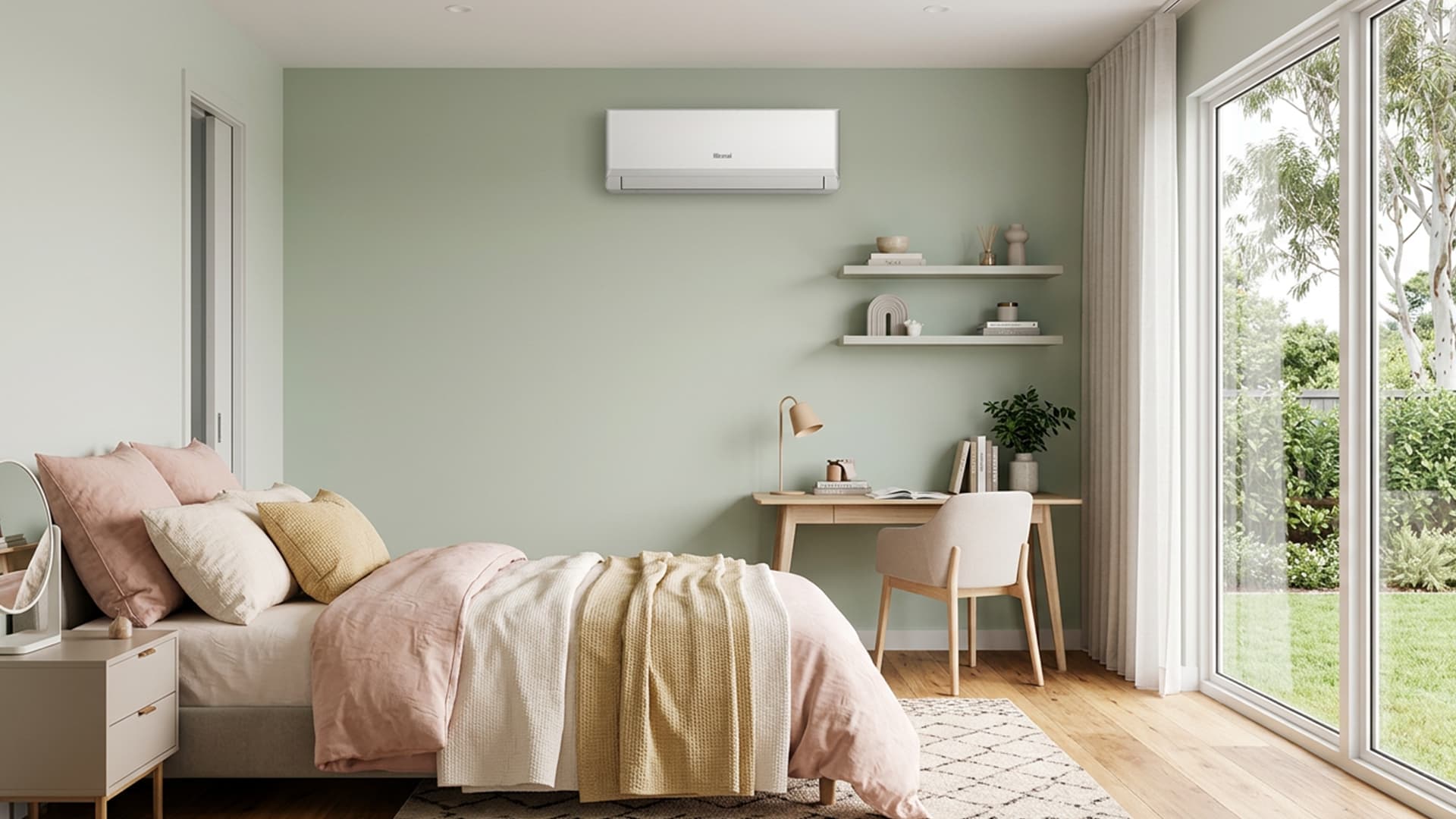
Ducted Air Conditioners
A centralised system that delivers heating and cooling through discreet ceiling or floor vents, controlled from a single wall panel or app. The indoor unit remains hidden in the ceiling or under the floor, creating a clean and uncluttered look.
BEST FOR: whole-home comfort, larger floor plans, or anyone who wants a clean, built-in look with zone control.
Mini VRF Air Conditioning
Variable Refrigerant Flow systems scale up to handle multiple zones with precise, independent temperature control in each one. This offers greater flexibility and capacity than a multi split system for larger or more complex layouts.
Best for: larger homes, multi-level properties, or small commercial spaces that need more capacity and zoning flexibility than a standard multi split can offer.
Portable Air Conditioners
A standalone unit that needs no permanent installation, just plug it in and vent it through a window or door gap. Portables trade some efficiency and quiet operation for flexibility.
BEST FOR: renters, temporary cooling needs, or spot-cooling a room where a fixed system isn't an option.
Note: heating systems (gas and electric) are covered in a separate guide.
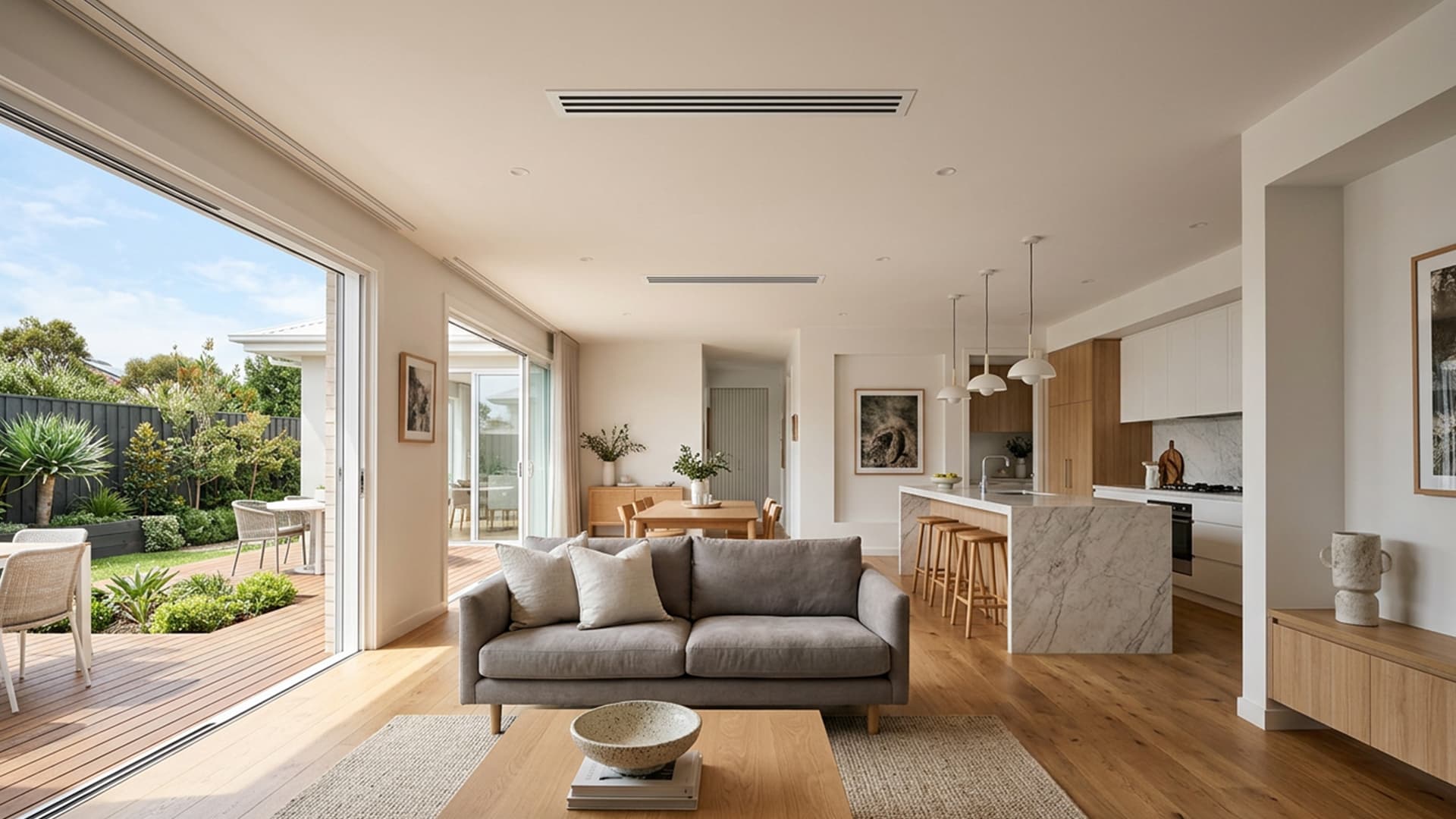
2. Working out What Size Do I Need
It's tempting to think bigger is always better, but the right air conditioner size comes down to matching the unit's cooling capacity (kW) to the room it needs to heat and cool. Get it wrong and you'll either pay for capacity you don't need, or end up with a system that runs constantly and still can't keep up.
Start With Your Room Size
Room size | Typical spaces | Most common capacity |
Small (up to 20 m²) | Bedroom, study, small kitchen | 2.5 kW |
Medium (20 to 40 m²) | Bedroom with ensuite, small lounge | 3.5 kW |
Large (40 to 60 m²) | Large bedroom, mid-sized lounge, large kitchen | 5.0 to 6.0 kW |
Extra large (60 m²+) | Open-plan living areas, large lounges | 7.0 to 9.0 kW |
These are the sizes that work for most rooms in each band. If your room sits at the larger end of a band, gets a lot of sun, or has other factors below working against it, you may want to size up to the next capacity.
One System, or one room?
The table above sizes a single room. If you're heating and cooling more than one room, the question isn't really "how big is my space" but "how many rooms do I want on one system." A multi split or ducted system can serve rooms of any size, from a small bedroom to a large open-plan living area, they just connect multiple indoor units (or ducted zones) to a single outdoor unit instead of running a separate outdoor unit for each room. Ducted systems always need an onsite assessment, since they're sized around the whole home rather than a single room.
What Else Affects Sizing
Ceiling height. This guide assumes a standard 2.4m ceiling. Higher ceilings mean more air volume to condition, so consider sizing up for ceilings of 2.7m or higher.
Insulation. A well insulated room holds its temperature and needs less capacity. Older homes with little or no ceiling insulation may need more.
Window size and orientation. North-facing windows pick up strong sun for much of the day, west-facing windows cop the harshest afternoon sun, and east-facing windows get milder morning sun. Large or unshaded windows in any direction increase the load further.
Local climate. A room in Darwin or Cairns needs more cooling capacity than the same room in Melbourne or Hobart, since the system works against a higher outdoor temperature for more of the year.
Number of occupants. A room used regularly by several people, or one that doubles as a home office or kitchen, holds more heat than the room size guide alone accounts for.
Why This Matters
Undersized systems run constantly, struggle to reach the set temperature, and wear out faster. Oversized systems cool the room too quickly, switch off before properly removing humidity, and cost more upfront than necessary. The right size keeps the room comfortable, keeps running costs down, and helps the unit last.
Get it right the first time.

3. Energy Efficiency Guide
Two air conditioners can look almost identical on the showroom floor and still cost very different amounts to run. Understanding a few key terms will help you compare systems properly and choose one that keeps your energy bills in check.
Star Ratings
Every air conditioner sold in Australia carries an energy rating label, from 1 to 10 stars, based on independent testing. More stars mean better efficiency, so the system uses less energy to deliver the same heating or cooling output. It's one of the fastest ways to compare two units at a glance, though it's worth checking the rating for both cooling and heating, since they can differ.
Rinnai's JX Series leads the market with up to a 9-star energy efficiency rating, among the highest available in Australia. That translates directly into lower running costs without compromising on cooling or heating performance.
Each label shows separate star ratings for cooling and heating, along with the model's estimated annual energy consumption in kWh, so you can compare two systems on a like-for-like basis rather than relying on the star count alone.
Inverter Technology
Older, non-inverter air conditioners run at a fixed speed, switching fully on and off to maintain temperature. Inverter systems adjust the compressor speed continuously, ramping up when needed and easing back once the room reaches temperature. This means less energy wasted on start-stop cycles, steadier temperatures, and quieter operation. All of Rinnai's current split system ranges use inverter technology.
Running Costs
Star ratings tell you how efficient a system is, but the real number that matters is what it costs to run in your home.
Innovative and efficient
Estimated Annual Electricity Usage
Running costs depend on your system's capacity, star rating, climate zone, and how often you use it. As a rough guide, a well-matched, high-efficiency split system running through a typical Australian summer costs a fraction of an older, non-inverter unit of the same size. The articles above break down real dollar estimates by series and climate zone using the Australian Government's Energy Rating Calculator.
★★ Energy Saving Tips ★★
Set the thermostat to 24 to 26°C in summer. Every degree cooler can add several percent to your running cost.
Use a timer or smart control so the system isn't running when nobody's home.
Close doors, blinds, and curtains during the hottest part of the day to reduce heat gain.
Clean filters regularly. A dirty filter forces the system to work harder for the same result.
Choose the right size system for the room. Oversized and undersized units both waste energy.
4. Features Comparison
Every Rinnai split system shares a solid foundation, but the details that matter most to you might differ depending on which series you choose. Here's what to look for.
JX Series | PX Series | TX Series | VX Series | |
Energy star rating (up to) | 9 star | 7 star | 5.5 star | 6.5 star |
Smart Control | Yes | Yes | Yes | Yes |
Self-cleaning | Yes | Yes | Yes | Yes |
HEPA Filtration | No | Yes | Yes | No |
Quiet operation (as low as) | 24 dB(A) | 19.5 dB(A) | 19.5 dB(A) | 31 db(A) |
Smart Control
Every current split system in the range can be controlled remotely from your phone. The JX and VX Series use the AC Freedom app while the PX and TX Series use the NetHome Plus app. Both let you adjust temperature, change modes, and check on your system from anywhere with an internet connection. All split systems can also be connected to Google Home and Amazon Alexa, so you can control them by voice or include them in existing smart home routines.
Self-cleaning
Built into every series, this feature runs a drying cycle after each use to reduce mould and bacteria build-up inside the indoor unit, keeping performance and air quality consistent between services (requires manual activation).
HEPA filtration
Available on the PX and TX Series, HEPA filtration reduces up to 99%^ of bacteria and dust particles, helping deliver cleaner, healthier indoor air for everyday comfort.
^Tested by Intertek, Report No. 250626075GZU-007 and 250626075GZU-001, an independent third-party laboratory.
Quiet Operation
Every system has a rated minimum decibel level. As a reference point, 30 dB(A) is roughly as quiet as a soft whisper or a quiet library. The lower the number, the better suited a system is to a bedroom or a home where noise matters.
Rinnai uses a third-party application (App) to enhance your experience of the Rinnai product. You may use the App at your sole discretion. Please note that when you download and use the App and its services, the third-party's privacy policy and terms and conditions of service will apply. By using the Rinnai product through this App, you acknowledge and agree that: the third-party App may collect, store, and process your personal information according to its own privacy policy and App terms and conditions; Rinnai does not control and are not responsible for the content, policies, or practices of the third-party App and its services; Rinnai strongly recommends that you review the App privacy policy before using its features; the use of the third-party App is optional. For further information or clarification, please contact us at 1300 555 545 and [email protected].
5. Installation Guide
Why professional installation matters
Installing a split system in Australia isn't a DIY job, it's the law. Handling refrigerant and connecting the refrigerant circuit requires an ARCtick licence from the Australian Refrigeration Council, and the electrical connection requires a licensed electrician. Rinnai's own guidance confirms this directly: DIY installation is illegal, can be unsafe, and voids the manufacturer's warranty. Requirements vary slightly by state, for example Queensland also requires a QBCC mechanical services licence.
Using an unlicensed installer voids the manufacturer's warranty, and most home insurance won't cover damage from unlicensed work either. Installations must also comply with AS/NZS 3666 and AS/NZS 5149 (mechanical ventilation and refrigerant handling) and AS/NZS 3000 (electrical wiring safety).
What to ask an installer before booking: You should request their ARCtick licence number and their state electrical licence number.
Indoor and outdoor unit placement
Indoor unit: High on an external wall, roughly 2 metres from the ground, clear of direct airflow onto beds or seating.
Outdoor unit: Stable, level surface with clearance for airflow. Your installer will confirm the exact clearances required for your chosen model and site conditions.
Indoor & outdoor unit placement: Typically, within 15 metres, depending on the manufacturer's specification.
Apartments and strata: Strata approval is often the bigger hurdle over council permits, worth checking before booking.
Typical installation process
Site assessment (airflow, sun exposure noise, electrical access)
Mounting the indoor unit bracket and securing the indoor unit
Drilling a wall penetration for refrigerant lines and drain
Positioning and securing the outdoor unit
Running and connecting refrigerant lines, electrical wiring (where applicable and condensate drain
Pressure-testing, evacuating and commissioning the refrigerant circuit, with additional refrigerant charged if required
Commissioning, testing, and walkthrough
Installation time and cost
A standard split system installation typically takes 3 to 6 hours, though double-storey homes, long pipe runs, or electrical upgrades can extend this. Multi split systems take longer, as each additional indoor unit adds to the job. Ducted systems typically take 1-3 days, depending on the home, system design and installation complexity. As a general guide, a standard split system installation costs $600 to $1,200, with more complex jobs costing more depending on access, wall type, and electrical requirements. Your installer can provide a firm quote upfront.
Things to prepare before installation
Confirm wall type (brick, weatherboard, double brick) and installation location
Check whether the electrical supply meets the system requirements
Consider the approximate distance between the indoor and outdoor unit locations
Check strata or body corporate requirements if applicable
Clear access to both indoor and outdoor installation areas
Ask your installer for their ARCtick licence number and electrical licence number upfront.
6. Running Costs
How much does it cost to run?
Running costs vary more than people expect between air conditioner models, even ones that look similar on the shelf. Running costs vary between air conditioner models, even when they look similar. Key factors include the system’s energy efficiency, capacity, climate zone, electricity tariff and how often you use it.
Here's how each Rinnai split system series compares to a competitor’s system of the same size, based on cooling costs in Australia's Hot climate zone:
Series | Star rating (up to) | Cooling savings vs competitor | Estimated savings per year | Estimated savings over 10 years |
JX Series | 9 star | Up to 64% | Up to $342 | Up to $3,426 |
PX Series | 7 star | Up to 57% | Up to $294 | Up to $2,943 |
VX Series | 6.5 star | Up to 53% | Up to $279 | Up to $2,794 |
TX Series | 5.5 star | Up to 50% | Up to $256 | Up to $2,568 |
These figures are based on the Energy Rating Calculator, comparing each Rinnai model against a similarly sized MEPS-approved system in the same climate zone. Your actual savings will depend on your specific climate zone, local electricity tariff, and how often you run the system.
Gas vs Electric
For heating, a modern reverse cycle air conditioner is generally cheaper to run than gas. This comes down to how each system works: gas heaters burn fuel directly, while a reverse cycle system is a heat pump, moving existing heat rather than generating it. This delivers more heat for each unit of electricity used.
Sustainability Victoria's published running cost data backs this up. For a 30m² room in a Melbourne climate, a reverse cycle system costs around $191 a year to run, compared to around $579 for a gas heater. At the whole-home level, a ducted reverse cycle system costs around $721 a year for a 100m² house, against around $1,540 for a gas ducted system.
Gas still has a role to play, particularly in existing homes with a working gas system, since replacing a system mid-life isn't necessarily worth it for running cost savings alone. For many Australian homes, a modern reverse-cycle air conditioner can be cheaper to run than gas heating, and it comes with the added benefit of also providing cooling, something a gas heater can't do.
Source: Sustainability Victoria, Calculate heating running costs (figures last updated July 2025). Note that Sustainability Victoria closed as an agency on 30 June 2026, with its functions transferring to DEECA, so this page is a static, non-updating source rather than live data.
Split vs Ducted
The honest answer is it depends on how many rooms you're conditioning. A split system only conditions the room it's installed in. For one or two rooms, split systems can be a more cost-effective option to install and run, particularly when you only need to condition those rooms. A ducted system can condition the whole home or selected zones through a network of ducts. If a ducted system is used to condition the whole home at once, it will generally use more energy than conditioning a single room.
Where ducted systems close the gap is zoning. A well-zoned ducted system can help reduce energy use by conditioning only occupied areas, while providing more consistent whole-home comfort. Split systems suit specific rooms, retrofits, and lower upfront cost. Ducted suits whole-home comfort and particularly in new builds where it can be designed in from the start.
Heating vs cooling costs
Whether heating or cooling costs more depends on factors such as your climate zone, system efficiency, electricity tariff and how often the system is used. Using the Rinnai JX Series 2.5kW as an example, estimated annual running costs in Australia's Average climate zone are around $180 for cooling and $68 for heating. In a Cold climate zone, this changes to around $43 for cooling and $452 for heating. In warmer regions, cooling may account for a larger share of annual air conditioning energy use, while in colder regions, heating may account for more.
Estimated running costs are based on the Energy Rating Calculator and the assumptions applicable to the nominated model and climate zone. Actual costs will vary depending on the home, electricity tariff, system settings and usage.
7. Climate Guide
Australia's climate varies enormously from state to state, and the right air conditioner for a tropical Queensland home isn't necessarily the right one for a cool Tasmanian one. Here's how to match a system to where you live.
Tropical Climate
Humidity, not just heat, is the main challenge in tropical regions like Far North Queensland and the Top End. The PX Series addresses this with adjustable humidity control, letting you set a target humidity level between 35% and 85% independently of temperature, avoiding the overcooling that can happen when a system works overtime just to pull moisture out of the air.
For homes in the far north where heating is rarely needed, Rinnai's CJ1 Series offers a cooling-only alternative. Available in NT, Northern QLD, and WA, it skips the heating function in favour of fast cooling, a high-density air filter, and an automatic self-cleaning cycle, at a lower cost than a full reverse cycle system.
Temperate Climate
Most of Australia's population lives in a temperate climate, with warm summers and mild-to-cool winters. This is where a genuinely reverse cycle system earns its keep, since it needs to perform well in both heating and cooling modes across the year rather than favouring one. Look for a system with a solid star rating in both modes rather than judging purely on the cooling figure.
Cool Climate
In cooler regions, heating carries most of the yearly running cost, which is exactly where a reverse cycle system's efficiency matters most. Unlike gas, which burns fuel directly, a reverse cycle system moves existing heat into your home, so it keeps costing less to run the colder it gets outside relative to gas. For genuinely cold climates, look for a model with a strong heating star rating rather than judging purely on the cooling figure, and check its rated operating range, most Rinnai split systems continue heating effectively well below 0°C. For the full cost comparison against gas, see our Running Costs guide.
Coastal Areas
Salt air is one of the harshest environments an outdoor unit can face, accelerating corrosion on the condenser coil and shortening the system's lifespan if it isn't properly protected. Rinnai's GoldGuard coating is built specifically to resist this, currently featured on the PX Series, TX Series, Multi Split System and Ducted System (excl. 20kW & 24kW). It also has a secondary benefit: it speeds up the defrost cycle, which improves heating efficiency in reverse cycle mode.
For coastal homes, this makes PX or TX the natural recommendation over a model without it.
Not sure what climate zone you're in?
Enter your postcode into the Australian Government's Energy Rating Calculator to find your climate zone and compare estimated air conditioner running cost
8. Government Rebates
Government energy efficiency schemes can reduce the upfront cost of a new air conditioner, though the details vary by state and are best confirmed directly with the relevant scheme.
Victorian Energy Upgrades (VEU)
Victoria's VEU program provides discounts on eligible energy-efficient upgrades, including reverse cycle air conditioning, delivered through accredited providers.
NSW Energy Savings Scheme (ESS)
New South Wales' ESS incentivises accredited providers to offer discounts on energy-efficient upgrades, including air conditioning.
SA Retailer Energy Productivity Scheme (REPS)
South Australia doesn't offer a fixed government rebate under REPS. Instead, its Retailer Energy Productivity Scheme (REPS) requires energy retailers to fund discounts on eligible upgrades, including high-efficiency reverse cycle air conditioners, delivered through accredited providers. Discount amounts vary, and larger discounts are available to concession card holders and other Priority Group households.
Other States and Territories
Queensland, Tasmania and the Northern Territory do not currently have a dedicated state energy-efficiency scheme for air conditioner upgrades comparable to Victoria's VEU, NSW's ESS or South Australia's REPS.
The ACT has other energy-efficiency programs, including the Sustainable Household Scheme, which can provide low-interest finance for eligible electric heating and cooling upgrades. Western Australia also offers an Air Conditioning Rebate for eligible households in specified locations, which helps with the cost of operating air conditioning rather than purchasing an AC system.
Government rebates, incentives and eligibility requirements can change, so check your state or territory government's current energy assistance programs before purchasing.
For further information visit the Australian Government’s current rebate finder website >
9. Warranty Information
Warranty Period
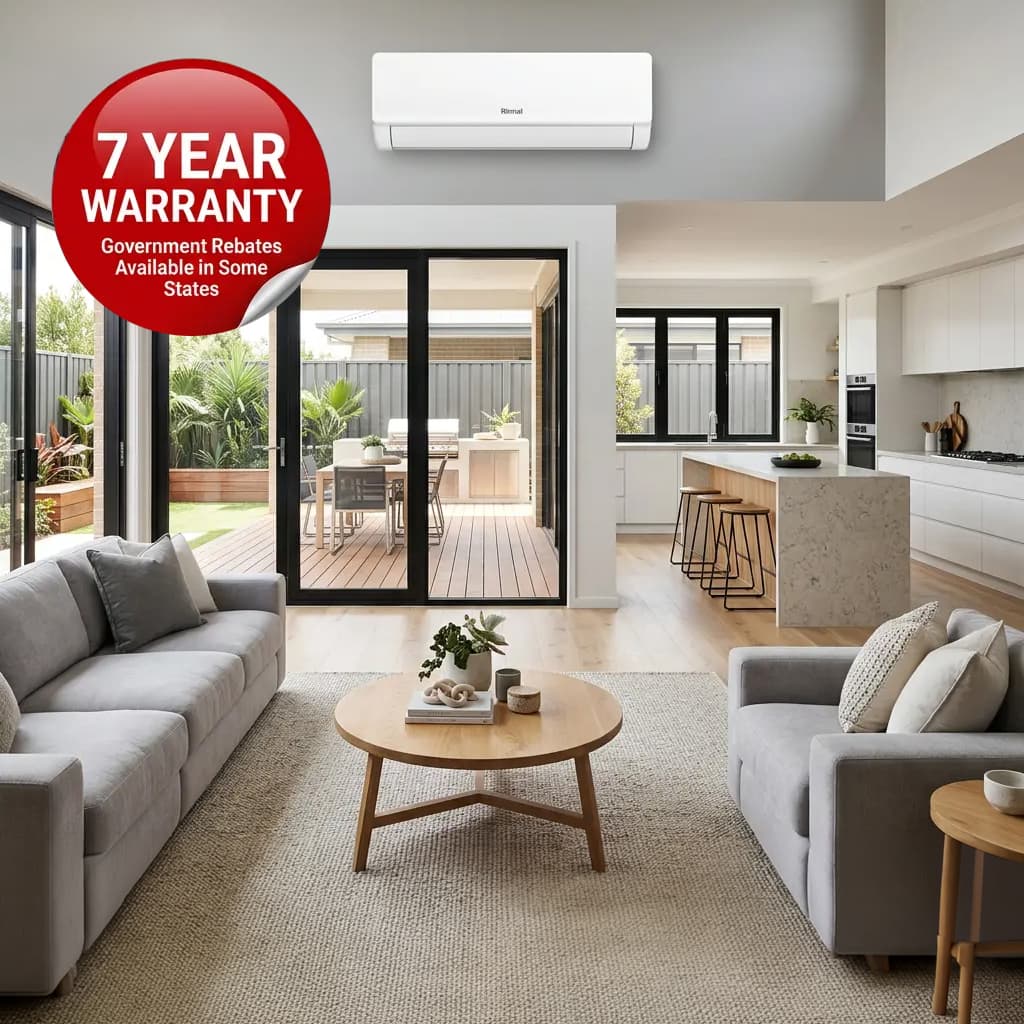
Every Rinnai split system in the range (JX, PX, TX, and VX Series) is backed by a 7 year warranty, extended from the previous 5-year term for products purchased from 1 April 2025. The warranty period runs from the date of installation, giving genuine long-term peace of mind across the whole split system lineup.
Registration Process
Registration is required within 12 months of installation to activate full warranty cover. It only takes a few minutes online.
Terms and Conditions
Full terms, exclusions, and claim procedures are set out in the Rinnai Air Conditioning Warranty Booklet, including callout fee responsibilities if an inspected fault turns out not to be covered. Customers should also be aware that Australian Consumer Law guarantees apply on top of, and independently of, this warranty.