:format(webp))
Rinnai is a name Australian households know and trust for home comfort.
Our range of air conditioners brings that same quality and reliability to heating and cooling, with our JX series leading the way at up to 9 star efficiency*. Choosing an efficient air conditioner means staying comfortable year round while keeping energy bills and environmental impact low. Whether you are cooling down over summer or heating your home through a cold snap, understanding how to read an energy rating label helps you choose the air conditioner that is right for your home.
How to read the label
The performance of air conditioners is affected by the climate it is operating in. For this reason, new non-ducted household air conditioners must display a new Zoned Energy Rating Label that considers the climate you live in. The label provides an energy rating for three climate zones (hot, average and cold), helping you select an appliance that performs best in your location. Estimated annual energy use in kilowatt hours (kWh) is provided on the right of the label, for heating (red) and cooling (blue) in each climate zone. In addition, it has output capacity for heating at two outdoor temperatures and cooling at one outdoor temperature, as well as noise indicators at the bottom to show the volume in decibels (dB(A)) of the air conditioner.
The image below calls out the 6 key parts of the energy label.
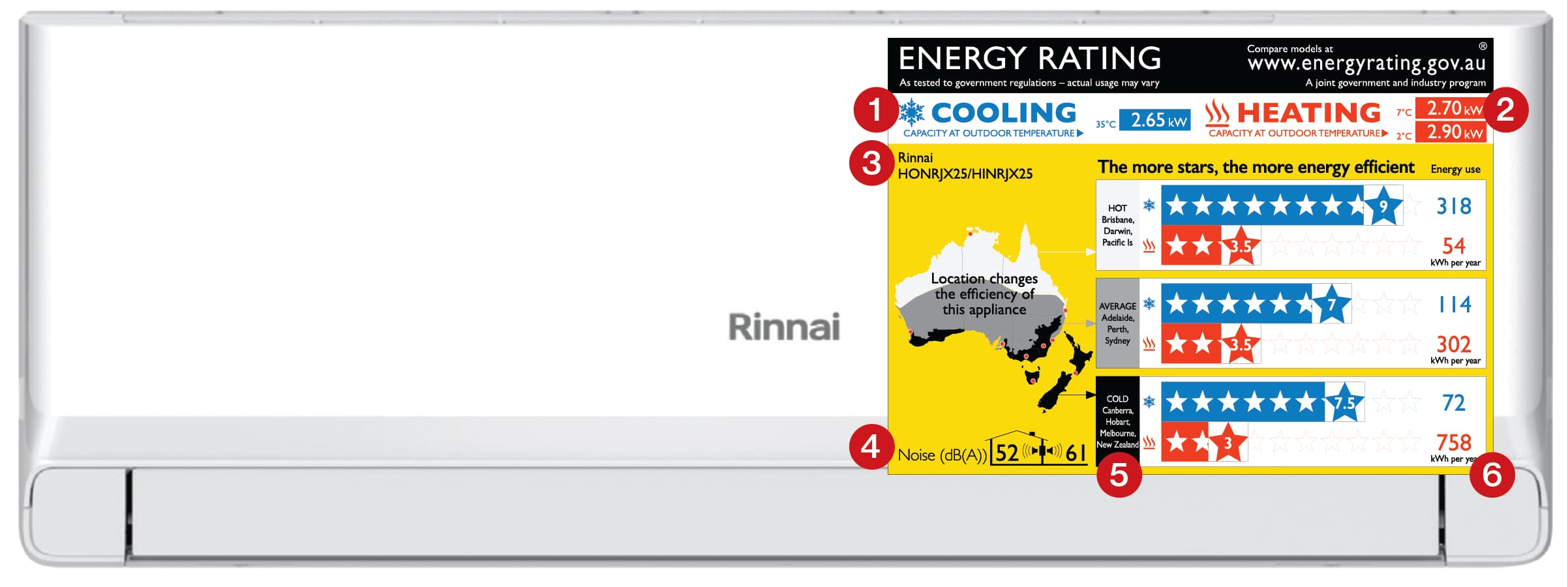
Cooling Capacity: The amount of cooling the Air Conditioner can provide when the outside temperature is above 35°C.
Heating Capacity: The amount of heating the Air Conditioner can provide when the outside temperature is 7°C and below 2°C.
Model Name and Number
Noise Levels - Sound Power: How loud the Air Conditioner will be when it is running. The number inside the house shows the inside noise levels, the number outside of the house illustrates the noise levels near the outdoor unit.
Efficiency Ratings Based on Locations: The efficiency of a product will change, dependent on the location in which it operates. There are three bands of ratings - Hot, Average and Cold areas in Australia and New Zealand. Use the map to determine which band to use.
Electricity usage: How much electricity the Air Conditioner will use each year for heating and cooling.
Now that you know how to read an energy rating label, you can make a confident choice for your home. Look for the star rating, check the kWh figures for your climate zone, and factor in noise levels if the unit will sit near a bedroom or living area.
Explore the Rinnai range to find the air conditioner that suits your space, your climate zone and your energy goals.
*2.5kW models in cool mode in hot climates.