:format(webp))
This buyer’s guide will help you choose the right hot water system for your home, budget and household needs.
We'll explore the different types of hot water systems available, including electric, gas, heat pump and solar options, and explain how to determine the right size based on your hot water usage. You'll also learn about energy efficiency ratings, running costs, the latest hot water technologies, and available government rebates that can help reduce upfront costs. By understanding these key factors, you can make an informed decision and invest in a reliable, cost-effective hot water solution for years to come.
1. Understanding the key differences between our hot water systems
Rinnai offers a range of hot water solutions to suit different Australian homes. These options include
Gas Continuous Flow for endless hot water on demand.
The Rinnai Infinity Gas Continuous Flow system heats water instantly as it passes through the unit, eliminating the need for a storage tank. Powered by natural gas or LPG, it delivers a continuous supply of hot water on demand, making it ideal for households of all sizes. When a hot water tap is turned on, the system automatically ignites and heats the water to the set temperature, providing efficient and reliable hot water whenever it's needed.
Electric Continuous Flow for gas-free properties.
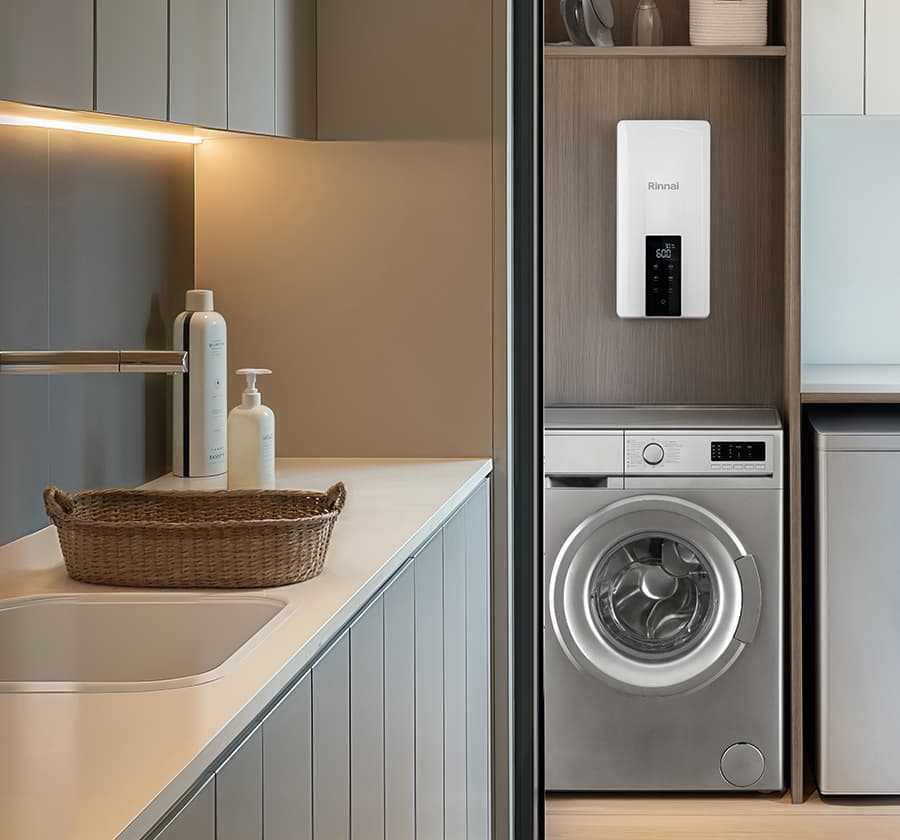
The Rinnai Efinity is a fully electric, continuous flow hot water system that heats water instantly as it flows through the unit — without the need for a storage tank. It operates using 3-phase power and is available in high-capacity models, making it suitable for homes with high hot water demand. When a hot water tap is opened, the system automatically activates and begins heating water to the set temperature.
Heat Pump Systems for the lowest running costs and carbon footprint.
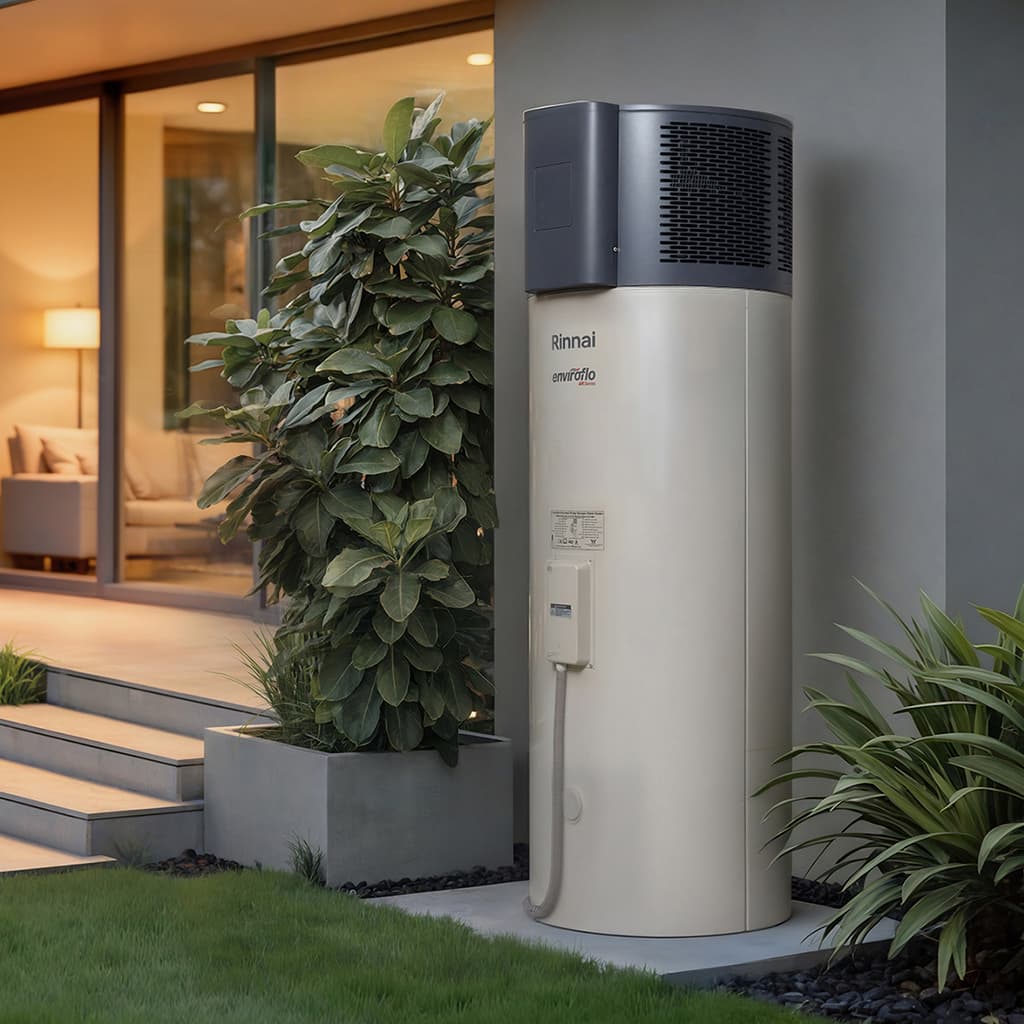
Heat Pump hot water units operate using the same technology as reverse cycle air conditioners. They use a refrigerant gas that absorbs heat from the surrounding air. Through a reverse cycle refrigeration process, this heat is transferred to the water via a heat exchanger. The system continues circulating until the water in the storage tank reaches the set temperature. This method is highly energy-efficient because it uses ambient air to heat water, even in cooler conditions, without relying solely on electric heating elements.
Storage Tanks for straightforward, budget-friendly installations.
A Storage hot water system heats and stores water in an insulated tank, ensuring hot water is readily available throughout the home. Available in electric or gas models, and in a range of sizes to suit different household needs. These systems automatically heat and maintain the water at a set temperature, reheating as hot water is used. Storage systems are a reliable and familiar hot water solution, offering consistent performance for everyday hot water demand.
Solar Hot Water for households maximising renewable energy.
A Solar hot water system uses rooftop solar collectors to heat water stored in a tank, with a gas or electric booster providing additional heating when needed. The two main types are close-coupled systems, where the tank and collectors are mounted together on the roof, and split systems, where the tank is located on the ground and a pump circulates water to and from the rooftop collectors.
The right choice depends on your household size, gas access, budget, and energy goals.

2. Choose the right size system for your home
Sizing depends on your system type. Storage and heat pump systems are sized by tank capacity against household size, ranging from 180L for 3–4 people up to 400L for larger households of 7–8. Continuous flow systems are sized differently, based on how many showers or outlets might run at once, with climate also playing a role since colder incoming water needs more heating capacity. A typical family of four suits a 250L to 315L storage or heat pump system, or a mid-range continuous flow model sized to simultaneous usage.
What Size Hot Water System do I need?
Gas Continuous Flow
Infinity B12: Warm/Cool climate → 1 shower outlet.
Infinity B16: Warm/Cool climate → 1 shower outlet.
Infinity B20: Warm climate → 1-2 shower outlets | Cool climate → 1 shower outlet.
Infinity B26: Warm climate → 1-3 shower outlets | Cool climate → 1-2.5 shower outlets.
Infinity 28i: Warm climate → 1-3 shower outlets | Cool climate → 1-2.5 shower outlets.
Infinity 32: Warm climate → 2-4 shower outlets | Cool climate → 2-3 shower outlets.
Electric Continous Flow
Efinity 14kW: Shower outlets → 1 | Sink outlets → 1 | Basin outlets → 2.
Efinity 19kW: Shower outlets → 1 | Sink outlets → 2 | Basin outlets → 3.
Efinity 29kW: Shower outlets → 2 | Sink outlets → 2 | Basin outlets → 4.
Heat Pump Systems
Models Enviroflo S 5.0kW: 250L → up to 5 people | 315L → up to 6 people.
Enviroflo S 7.0kW: 250L → up to 5 people | 315L → up to 6 people | 400L → up to 8 people.
Enviroflo AR Series: 300L → up to 6 people | 340L → up to 7 people.
Enviroflo GR Series: 215L → up to 4 people | 280L → up to 5 people | 300L → up to 6 people.
Enviroflo A Series: 180L → up to 3 people.
Enviroflo 265L: 265L → up to 5 people.
Hotflo Plus 250L: 250L → up to 5 people.
Storage Tanks
As a general guide, you’ll need about 50 litres of hot water per person, plus an extra 50 litres to cover those busy times when everyone’s using hot water at once.
1–2 people → around 125L.
3–4 people → around 250L.
5 or more people → 315L or larger.
3. Dealer Network
Rinnai products are not sold directly to the public. Instead, our complete range is supplied and installed through a trusted network of authorised specialists, dealers, and retailers located throughout Australia. This approach ensures customers receive genuine Rinnai products along with professional guidance, expert installation, and ongoing support from trained industry professionals who understand the specific requirements of your home and hot water, heating, or cooling needs.
To find a convenient supplier near you, use our Supplier Locator >
The tool allows you to search for authorised Rinnai outlets in your local area, view available product ranges, and connect with experienced specialists who can provide personalised recommendations. Whether you're replacing an existing system, building a new home, or exploring energy-efficient solutions, your local authorised Rinnai supplier can help you choose the right product and ensure it is installed correctly for optimal performance and reliability.
4. Government Rebates
Government Rebates
Several government schemes can reduce the upfront cost of upgrading to a Rinnai hot water system, particularly heat pump and solar options. These vary by state, and in most cases stack with each other. Please note this is a general overview only. Your local dealer can confirm exactly what you're eligible for and apply any relevant discount to your quote.
Solar Victoria Hot Water Rebate (VIC)
Victorian households can receive a rebate of up to $1,000 on an eligible heat pump or solar hot water system, or up to $1,400 if the product is locally made. Several Rinnai heat pump models are on the current locally made eligible list. The rebate is a 50% discount on the purchase price, calculated after other discounts like STCs, and requires an existing eligible system at least 3 years old plus a household income cap.
Victorian Energy Updates (VIC)
Separately to the Solar Victoria rebate, VEU offers an upfront discount through accredited providers when replacing an inefficient electric or gas system with a heat pump or solar-boosted system, up to $630–$910* depending on what's being replaced. Combining VEU with the Solar Victoria rebate can save Victorian households up to $1,960* on an eligible system.
*Values are accurate as of 30/9/2026. Please visit the Energy Victoria website for the most up-to-date information.
Energy Saving Scheme (NSW)
NSW households and small businesses can access an upfront installer discount of up to $640* when replacing an electric water heater with a heat pump, or up to $330* when replacing gas with a heat pump. The actual discount varies by installer and system, so it's worth comparing quotes from a few accredited providers.
*Values are accurate as of 30/9/2026. Please visit the Energy NSW website for the most up-to-date information.
Small-scale Technology Certificates – STCs (Federal)
Available nationwide, STCs apply to eligible solar hot water systems and air source heat pumps and can be claimed directly or assigned to a registered agent for an upfront discount on the purchase price. The value depends on your location and system size.
Official Government Information
Rinnai Claim Forms
5. Warranty Information
Registration Process
Registering your product ensures Rinnai has your details on file to speed up any warranty claims during the warranty period.
Terms and Conditions
Full terms, exclusions, and claim procedures are set out in the relevant Rinnai Warranty Booklet for youra product type, including callout fee responsibilities if an inspected fault turns out not to be covered. Australian Consumer Law guarantees apply on top of, and independently of, this warranty.
How to Book a Service
Rinnai's national service network, 1stCare, handles service, repair, and warranty assessment work for hot water systems Monday to Friday, 8:30am to 5pm AEST. Book online or call 1300 555 545.